Under Sink Storage Ideas for Small Bathrooms: Maximize Every Inch
The area under a bathroom sink is often one of the most useful storage spaces in a small bathroom. However, it can also become one of the most difficult areas to organize.
Plumbing pipes take up valuable room, cleaning products create clutter, and small items can easily disappear behind larger bottles. Without a simple system, the cabinet quickly becomes a crowded space where it is difficult to find what you need.
The good news is that you do not need a large bathroom or an expensive renovation to improve under-sink storage. With the right containers, shelves, organizers, and layout, you can use the available space much more effectively.
These under sink storage ideas for small bathrooms will help you organize everyday essentials, make better use of vertical space, and keep your bathroom cabinet neat and easy to maintain.
Quick Answer: How Do You Maximize Under Sink Storage in a Small Bathroom?
The best way to maximize under sink storage is to declutter first and then organize items around the plumbing. Use stackable bins, pull-out drawers, clear containers, door organizers, and vertical storage to make better use of every available inch.
Keep frequently used items near the front and store cleaning products or extra supplies toward the back. Avoid filling the cabinet completely because some empty space makes it easier to access and maintain.
Under Sink Storage Ideas at a Glance
| Storage Solution | Best For | Main Benefit |
|---|---|---|
| Stackable bins | Toiletries and supplies | Uses vertical space |
| Pull-out organizers | Frequently used items | Easy access |
| Clear containers | Small items | Easy to see |
| Door organizers | Small accessories | Uses unused space |
| Adjustable shelves | Different item sizes | Customizable |
| Lazy Susan | Bottles and toiletries | Easy access |
| Storage baskets | Towels and supplies | Keeps categories together |
| Over-the-pipe organizer | Working around plumbing | Uses awkward space |
1. Start by Emptying and Decluttering the Cabinet
Before adding storage products, remove everything from under the sink.
Place all items on a towel or nearby surface and sort through them.
You may find:
- Empty bottles
- Expired products
- Duplicate items
- Products you no longer use
- Old cleaning supplies
- Random items that belong somewhere else
Throw away or recycle items that are no longer useful according to local disposal guidance.
Then group the remaining items into categories.
For example:
- Daily toiletries
- Hair products
- Skincare products
- Cleaning supplies
- Extra toilet paper
- Backup products
This gives you a clearer idea of how much storage space you actually need.
2. Measure the Space Around the Plumbing
One of the biggest challenges of under-sink storage is the plumbing.
Pipes can make standard shelves and storage boxes difficult to use.
Before purchasing organizers, measure:
- Cabinet width
- Cabinet depth
- Cabinet height
- Distance around the pipes
- Space between the pipes and cabinet walls
Also note where the pipes enter the cabinet.
This will help you choose organizers that fit around them.
Adjustable storage solutions are often more practical than fixed shelves because they can be arranged around the plumbing.
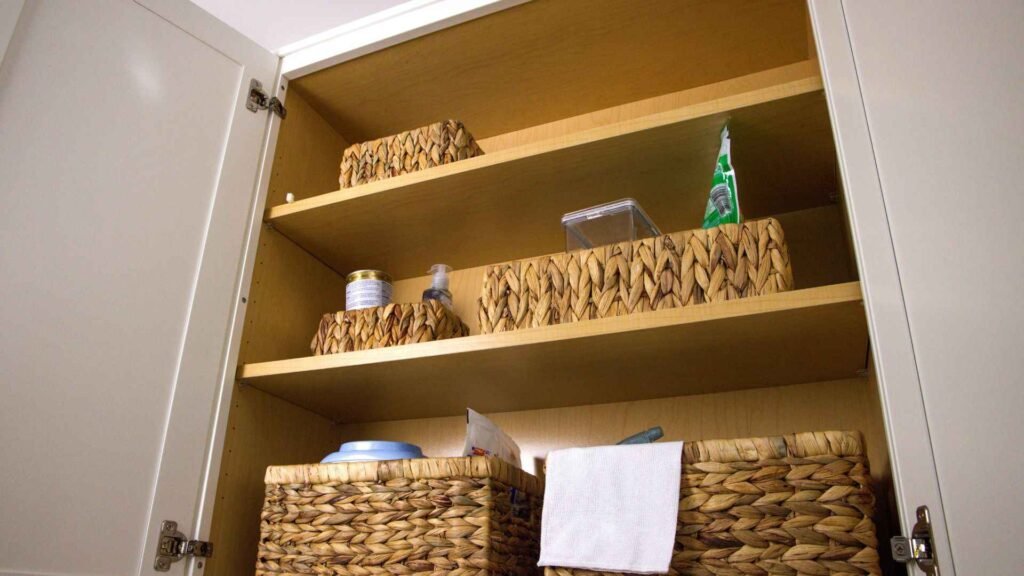
3. Use Stackable Storage Bins
Vertical space is often wasted inside under-sink cabinets.
Stackable bins can help you store more items without creating a large pile.
Use separate bins for categories such as:
- Skincare products
- Hair products
- Extra toiletries
- Cleaning supplies
Choose bins that can be easily removed.
This allows you to pull out the entire category instead of reaching into the back of the cabinet.
Avoid stacking bins so high that you cannot comfortably access the top or bottom containers.
4. Add Pull-Out Storage Drawers
Pull-out organizers can be especially useful in deep cabinets.
Instead of reaching behind several bottles, you can pull the organizer forward.
These are helpful for:
- Toiletries
- Small bottles
- Hair products
- Cleaning supplies
- Extra bathroom items
Look for organizers designed to work around plumbing pipes.
Some designs have separate sections that leave an open space for pipes.
Pull-out drawers can make the back of a deep cabinet much easier to use.
5. Use Clear Containers for Small Items
Small items can quickly become lost in a large cabinet.
Clear containers make it easier to see what you have.
They work well for:
- Cotton balls
- Cotton swabs
- Small skincare products
- Dental supplies
- Travel-size toiletries
Clear storage can also help prevent you from buying duplicates because you can easily see your remaining supplies.
Choose containers that fit the cabinet dimensions rather than purchasing containers based only on appearance.
6. Organize Cleaning Supplies Safely
Under the bathroom sink is a common place to store cleaning supplies.
However, cleaning products can take up significant space.
Group similar products together and keep only the products you actually use.
You may have separate items for:
- Sink cleaning
- Mirror cleaning
- Toilet cleaning
- General bathroom cleaning
If you have children or pets, consider safety when storing household cleaning products and follow the product label instructions.
A removable storage bin can make cleaning easier because you can take the supplies out together when needed.
Avoid placing products directly against plumbing if leaks or moisture are possible.
7. Make Use of the Cabinet Door
The inside of the cabinet door can provide additional storage.
Depending on your cabinet design, you may be able to add:
- Small baskets
- Adhesive organizers
- Hooks
- Slim racks
These can hold lightweight items such as:
- Hair brushes
- Small towels
- Cleaning cloths
- Sponges
- Small bottles
Make sure the door can close properly before installing anything.
Avoid adding large or heavy items that could interfere with the cabinet’s movement.
8. Use a Lazy Susan for Easy Access
A small rotating tray can make bottles easier to reach.
Instead of moving several products to find one item, simply rotate the tray.
A Lazy Susan can work well for:
- Skincare bottles
- Hair products
- Daily toiletries
Choose a tray with raised edges to help prevent bottles from falling when it rotates.
This option is usually best when the cabinet has enough open space and the plumbing does not interfere.
9. Store Items by How Often You Use Them
Not everything under the sink needs to be equally accessible.
Organize based on frequency of use.
Frequently Used Items
Keep these near the front.
Examples include:
- Daily toiletries
- Frequently used cleaning products
- Hair products
Occasionally Used Items
Store these toward the middle or side.
Examples may include:
- Extra skincare products
- Specialty cleaning products
- Travel items
Backup Supplies
Store these toward the back.
Examples include:
- Extra soap
- Replacement toiletries
- Backup cleaning products
This system makes the cabinet more practical because the items you need most often are easiest to reach.
10. Add an Adjustable Shelf
A fixed shelf may not work well around plumbing, but an adjustable shelf can help create additional levels of storage.
Look for shelving that can be adjusted around pipes.
This can create separate areas for:
- Short bottles
- Small containers
- Extra toiletries
Use the lower area for taller products and upper storage for smaller items when possible.
Do not install a shelf that makes access to plumbing difficult if maintenance is needed.
11. Use Storage Baskets for Categories
Baskets can help keep similar items together.
For example, you could have one basket for:
- Hair products
- Skincare
- Cleaning supplies
- Extra toiletries
Instead of organizing every individual item separately, organize by category.
This makes it easier to maintain the system.
Choose baskets with handles so they can be pulled out easily.
In a small cabinet, rectangular baskets often use space more efficiently than round containers.
12. Try an Over-the-Pipe Organizer
The space around plumbing can feel awkward, but specialized organizers are designed to work around pipes.
These organizers may include adjustable shelves or narrow compartments that fit on either side of the plumbing.
They can help you use space that would otherwise remain empty.
Before purchasing one, carefully measure the pipe location and available cabinet space.
Not every under-sink organizer fits every bathroom cabinet.
13. Use Hooks for Small Bathroom Accessories
Hooks can help you use vertical space inside the cabinet without adding large storage containers.
Depending on the cabinet design, small adhesive hooks can hold lightweight items such as:
- Hair tools
- Small cleaning brushes
- Washcloths
- Gloves
- Reusable cleaning cloths
Hooks are especially useful for items that would otherwise take up space inside bins.
Before installing anything, make sure the hooks will not interfere with the cabinet door or plumbing.
Keep heavy items off adhesive hooks unless the product is specifically designed to support them.
14. Add a Tension Rod for Cleaning Bottles
A tension rod can create an additional storage area inside some under-sink cabinets.
Place the rod horizontally across the cabinet and hang spray bottles from their trigger handles.
This can free up the bottom of the cabinet for other items.
A tension rod may work well for:
- Bathroom cleaning sprays
- Multipurpose cleaners
- Small spray bottles
The available space below the bottles can then be used for bins or baskets.
Measure the cabinet carefully before using this method to ensure the rod does not interfere with pipes.
15. Store Toilet Paper in a Small Basket
Extra toilet paper can take up more space than expected.
Instead of placing loose rolls throughout the cabinet, keep them together in a dedicated basket or container.
Depending on the cabinet size, you may store:
- One or two backup rolls
- Extra tissue boxes
- Other paper products
Avoid filling too much under-sink space with toilet paper if other storage areas are available.
In a very small bathroom, a separate wall-mounted or freestanding toilet paper storage solution may be more practical.
16. Use Narrow Containers Along the Cabinet Sides
The space beside plumbing pipes is often narrow and difficult to use.
Slim containers can help make use of these areas.
They may be useful for storing:
- Small bottles
- Toothpaste
- Dental supplies
- Hair accessories
- Cleaning cloths
Measure the available width before choosing containers.
Narrow rectangular bins are often better than round containers because they fit more efficiently against the sides of the cabinet.
17. Maximize the Back of a Deep Cabinet
Deep under-sink cabinets can create another problem: items stored in the back are difficult to reach.
Use removable bins or pull-out organizers to make the entire depth accessible.
Store less frequently used items toward the back, including:
- Backup toiletries
- Extra soap
- Replacement products
- Specialty cleaning supplies
Keep daily items near the front.
If you need to remove several products every time you reach the back, the storage system may need to be adjusted.
18. Group Similar Products Together
One of the easiest ways to keep an under-sink cabinet organized is to create simple categories.
For example, you might have separate groups for:
Daily Bathroom Essentials
- Toothpaste
- Skincare products
- Hair products
Cleaning Supplies
- Bathroom cleaner
- Glass cleaner
- Cleaning cloths
Backup Products
- Extra soap
- Replacement toiletries
- Additional personal care products
Grouping items together makes it easier to find what you need and helps prevent random clutter from accumulating.
You do not need a separate container for every product. Simple categories are easier to maintain.
19. Use Labels to Maintain the System
Labels can be helpful if several people use the bathroom.
You can label bins or baskets with simple categories such as:
- Cleaning
- Hair
- Skincare
- Extras
- Dental
Labels are particularly useful for opaque containers where the contents are not visible.
Keep the labels simple and easy to understand.
The goal is to make it easier for everyone to return items to the correct place.
20. Use Stackable Drawers for Maximum Vertical Space
If your plumbing allows it, stackable drawers can help organize small products.
These are useful for:
- Makeup
- Skincare
- Dental products
- Small toiletries
- Travel-size products
Drawers can be more convenient than stacking regular containers because you can access the bottom section without removing everything on top.
However, make sure the drawers can be pulled out fully without hitting the cabinet door or plumbing.
21. Store Small Towels and Washcloths
If you have enough space, an under-sink cabinet can store small bathroom linens.
Fold or roll washcloths and small towels to keep them organized.
Use a basket or container to separate:
- Clean washcloths
- Cleaning cloths
- Small hand towels
Keeping bathroom linens together prevents them from becoming mixed with cleaning products or toiletries.
Avoid storing damp towels inside a closed cabinet because moisture can create unpleasant odors.
22. Choose Removable Organizers
Removable organizers are often more practical than permanent storage solutions.
They allow you to:
- Clean the cabinet easily
- Rearrange your storage
- Access items quickly
- Adjust the layout when your needs change
Handles are particularly useful because you can pull out a complete category of products.
For example, you can remove an entire cleaning supply bin instead of taking out individual bottles.
23. Make Use of Every Available Height
Many under-sink cabinets have unused vertical space above shorter products.
Look carefully at the cabinet and identify areas where you can add:
- Small shelves
- Stackable bins
- Narrow drawers
- Door organizers
At the same time, remember that the plumbing may limit your options.
The goal is not to fill every empty inch. Instead, use vertical space where it improves accessibility.
If stacking items makes it difficult to reach the products below, a different solution may work better.
24. Keep Plumbing Accessible
Organization should never make necessary plumbing access difficult.
Avoid permanently blocking:
- Water supply valves
- Drain pipes
- Pipe connections
If a leak occurs or maintenance is required, you should be able to remove storage items easily.
This is another reason removable bins and adjustable organizers can be useful.
A well-organized cabinet should make the space easier to use while still allowing access to important plumbing components.
25. Create a Simple Restocking System
Small bathrooms can quickly become cluttered when backup products accumulate.
Instead of storing large quantities of everything under the sink, create a simple restocking system.
Keep a reasonable number of:
- Extra soap
- Toilet paper
- Toothpaste
- Shampoo
- Other frequently used products
When supplies run low, replace them.
This prevents the cabinet from becoming a storage area for excessive backup products.

Under Sink Storage Ideas by Bathroom Size
Very Small Bathroom
For an extremely small bathroom, focus on compact and vertical solutions.
Try:
- Door organizers
- Slim bins
- Stackable drawers
- Small baskets
- Over-the-pipe storage
Avoid oversized containers that waste valuable space.
Small Bathroom With a Deep Cabinet
A deep cabinet can hold many items, but accessibility is important.
Use:
- Pull-out organizers
- Removable bins
- Lazy Susans
- Stackable storage
Keep frequently used items near the front.
Bathroom With Limited Plumbing Space
If pipes occupy much of the cabinet, use the remaining areas on either side.
Narrow containers and adjustable organizers can help you work around the plumbing.
Avoid forcing large storage products into awkward spaces.
Common Under Sink Storage Mistakes
Buying Organizers Before Measuring
Always measure the cabinet first.
An organizer may look perfect online but fail to fit around pipes or inside the cabinet.
Storing Too Many Products
An under-sink cabinet should not become a storage space for every bathroom product you own.
Keep only useful items and reasonable backup supplies.
Ignoring Vertical Space
Short containers can leave a large amount of unused space above them.
Consider stackable or adjustable storage when appropriate.
Keeping Everything Loose
Loose bottles and small items can quickly become messy.
Use simple bins or containers to keep categories together.
Blocking the Plumbing
Do not create a storage system that makes it difficult to access pipes or water valves.
Choose removable and adjustable solutions.
Making the System Too Complicated
A complicated organization system is difficult to maintain.
Use a few clear categories that make sense for your daily routine.
How to Keep Under Sink Storage Organized
Organizing the cabinet is only the first step. A simple maintenance routine can help keep it neat.
Return Items to Their Place
After using an item, return it to the appropriate bin or section.
Check for Empty Products
Remove empty bottles regularly so they do not take up unnecessary space.
Clean the Cabinet Occasionally
Take out the organizers and wipe down the cabinet.
Check for moisture or signs of leaks while cleaning.
Review Your Supplies
Every few months, check whether you have:
- Unused products
- Expired items
- Too many duplicates
- Empty containers
Removing unnecessary items keeps the storage system functional.
Final Thoughts
The best under sink storage ideas for small bathrooms focus on using limited space efficiently while keeping everyday essentials easy to access.
Start by decluttering and measuring the cabinet around the plumbing. Then group similar products together and choose storage solutions that fit your specific space.
Stackable bins, pull-out organizers, door storage, narrow containers, tension rods, and adjustable shelves can all help maximize available space.
Remember that an organized cabinet does not need to be packed completely full. Leaving some empty space makes it easier to find items and return them after use.
Keep frequently used products near the front and store backup supplies toward the back. Choose removable organizers so you can easily clean the cabinet and access the plumbing when necessary.
With these simple under sink storage ideas for small bathrooms, even a small and awkward cabinet can become a practical, organized storage space.
Frequently Asked Questions
How do I organize under a small bathroom sink?
Start by decluttering and measuring the available space around the plumbing. Use bins, drawers, shelves, and door organizers to group similar items and make better use of vertical space.
What is the best storage for under a bathroom sink?
The best storage depends on the cabinet layout. Stackable bins, pull-out organizers, adjustable shelves, narrow containers, and over-the-pipe organizers are all useful options.
How can I organize around under-sink pipes?
Measure the pipes and choose organizers that fit around them. Use narrow bins on either side, adjustable shelves, or organizers designed specifically for under-sink plumbing.
How do I maximize vertical space under a sink?
Use stackable bins, small shelves, drawers, or elevated organizers. Avoid stacking items in a way that makes the products underneath difficult to access.
Should I store cleaning supplies under the bathroom sink?
Cleaning supplies can be stored under the sink if the space is appropriate. Follow product label instructions, keep products organized, and consider safety around children and pets.